
High-Efficiency Titanium Wire for DED & WAAM 3D Printing
Engineered for Stable, Jam-Free Feeding in Robotic & CNC Systems
Accelerate your production cycles with ultra-pure titanium welding wire specifically refined for Directed Energy Deposition (DED) and Wire Arc Additive Manufacturing (WAAM) systems. Our material ensures zero defect integration and optimal melt-pool stability for large-scale aerospace and defense components.
The Challenge
Solving the critical failure points in large-scale metal additive manufacturing.
Internal Porosity & Hydrogen Cracking
Excessive hydrogen or hidden surface contaminants vaporize under high-energy welding arcs. This creates micro-porosity and dangerous hydrogen cracking within large-scale printed structures.
Wire-Feed Buckling & Jamming
Residual winding stress and wire "spring-back" memory cause the wire to twist or buckle inside the liner, abruptly halting your 24/7 automated production runs.
Melt-Pool Fluctuations
Minor variations in wire diameter disrupt arc stability and laser coupling. This results in inconsistent layer deposition and severe geometrical deviations in the final part.
Our Solution
Proprietary processing for the world’s most demanding fabrication systems.
Ultra-Low Hydrogen Metallurgy (H ≤ 0.0020%)
We utilize vacuum arc remelting (VAR) and controlled atmospheric baking to strictly limit hydrogen to ≤ 0.0020%. This effectively eliminates delayed cracking risks in flight-critical components.
In-Line Stress Elimination
Multi-stage ultrasonic degreasing ensures a 100% bare-metal finish. Combined with exact diameter tolerances (±0.02 mm), this guarantees a highly stable melt pool.
Precision Geometry & Surface Purity
Ultrasonic chemical cleaning and 100% laser-monitored sizing ensure a contamination-free surface and ±0.01mm diameter consistency.
- Technical Specifications
Item
Specification / Description
Product Name | High-Efficiency Titanium Wire for DED & WAAM 3D Printing |
Primary Alloys | TC4 (Ti-6Al-4V), TC11 (High-Temp Aerospace Ti), TA15 (High-Strength Ti), TA18 (Ti-3Al-2.5V) |
Chemical Control | 100% Custom Melted per Order. |
Wire Diameters | Φ1.2mm,Φ1.6mm,Φ2.4mm (Standard gauges for robotic DED/WAAM systems) |
Size Tolerance | ± 0.02 mm to ± 0.03 mm |
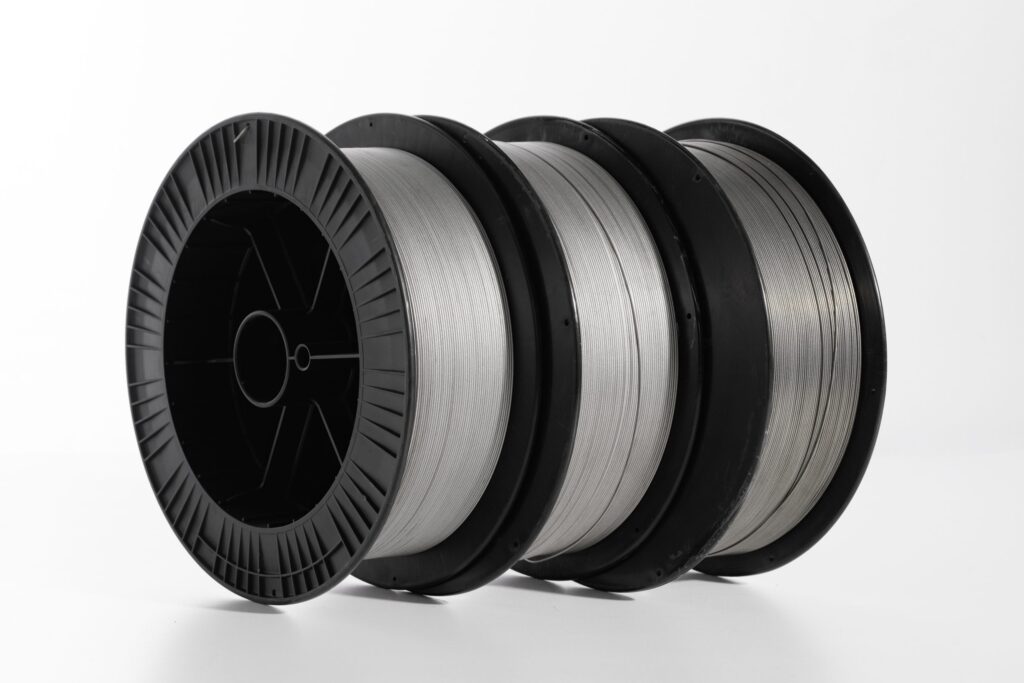
Packaging & Format | Precision Layer Wound: D300 Spools (5–10 kg/spool, tangle-free) |
- 100% Certified Quality Assurance
Every production run undergoes rigorous, non-negotiable verification. We issue a full EN 10204 3.1 Mill Test Certificate supported by third-party lab analysis of critical elements (O, H, N, C, Fe). Physically, 100% Eddy Current Testing inspects every meter for sub-surface defects, while real-time laser gauging locks the diameter within ±0.02 mm. The result is a contaminant-free, dimensionally stable wire, engineered for reliable feeding.
- Secure Packing
Every spool is vacuum-sealed in a moisture-proof bag immediately after inspection and packed into reinforced plywood crates with internal bracing to prevent shock damage during transit. The result is a clean, tangle-free spool ready for immediate loading into your robotic DED/WAAM system.
Frequently Asked Questions
Technical and logistical insights for your additive manufacturing operations.
Q1: What grades of titanium wire do you supply for DED and WAAM processes?
Answer: We primarily supply high-purity Ti-6Al-4V (Grade 5) and Ti-6Al-4V ELI (Grade 23) titanium wires, which are the industry standards for aerospace and medical applications. We also offer Commercial Pure Titanium (Grade 1, Grade 2) and customized titanium alloys upon request to meet specific additive manufacturing requirements.
Q2: How do you ensure the wire feeding stability during high-speed WAAM printing?
Answer: Wire feeding consistency is critical to prevent printing defects. Our titanium wires feature an optimized tensile strength rangeand a strict helix and cast control to prevent tangling or slipping in automated torch systems. Additionally, the wire surface is precision-drawn to guarantee a uniform diameter tolerance of within ±0.03 mm.
Q3: What surface treatments are applied to prevent porosity in titanium 3D printing?
Answer: Porosity is often initiated by surface contaminants. Our titanium wires undergo advanced chemical cleaning and ultrasonic washing, followed by vacuum bright annealing. This process effectively degasses hydrogen, minimizes surface oxides, and eliminates residual lubricants, ensuring stable plasma/laser beam interaction and a clean melt pool.
Q4: What are the standard spool sizes and packaging options available?
Answer: We offer standard D300 (15 kg/spool) and D200 (5 kg/spool) precision-wound plastic or wire spools compatible with global robotic WAAM systems. To prevent moisture absorption and oxidation during sea freight, each spool is vacuum-sealed in a moisture-proof bag with desiccant and packed in a sturdy export carton.
Q5: Can you provide samples of titanium wire for DED/WAAM print testing?
Answer: Yes, we highly support R&D and quality verification. We can provide sample spools (1 kg to 5 kg) for your engineering team to run trial prints and test deposition rates. Please contact our sales specialists to discuss your testing parameters and sample availability.
Get Your Precision DED/WAAM Wire Quote
Submit your requirements and our technical team will provide a tailored quotation within 24 hours.
Get a Quote
Connect with our metallurgical specialists to discuss your technical specifications.