
High-Purity Titanium Electrode Bars for Flawless EIGA & PREP Atomization
In-House VAR Melting & Precision Machining to Eliminate Vibration and Contamination
Stop production failures caused by rod defects. As a full-process manufacturer, we tailor every electrode bar to your exact drawings—guaranteeing ≤ 0.1mm/m straightness and aerospace-grade metallurgical integrity. Send us your specs, and we’ll deliver the stable melt stream your high-end powders demand.
The Risks of Inferior Electrode Bars
Catastrophic Vibration at 30,000 RPM
Any slight bend or lack of concentricity induces violent vibration. Without meeting extreme precision straightness standards, the rod will damage your high-speed atomizer.
Melt-Pool Instability & Clogging
Inaccurate geometries or unstable feed rates in EIGA cause uneven melting. This drops un-melted blocks into the nozzle, instantly clogging the atomization stream.
Powder Purity Contamination
Powder quality starts with the rod. Any micro-cracks, surface oxides, or inclusions will ruin the chemical purity of your final batch, spiking oxygen levels beyond acceptable limits.
ApexTiMill MATERIALS
Our Electrode Bar Solution
Micro-Vibration Control for Stable Rotation
We maintain straightness within ≤ 0.1mm/m via precision centerless grinding. Crucially, advanced stress-relief annealing eliminates internal deformation, preventing the micro-jitter that disrupts the plasma arc at 30,000 RPM. This guarantees a laminar molten stream and protects your high-speed atomizer.
Precision Geometry for Seamless Feeding
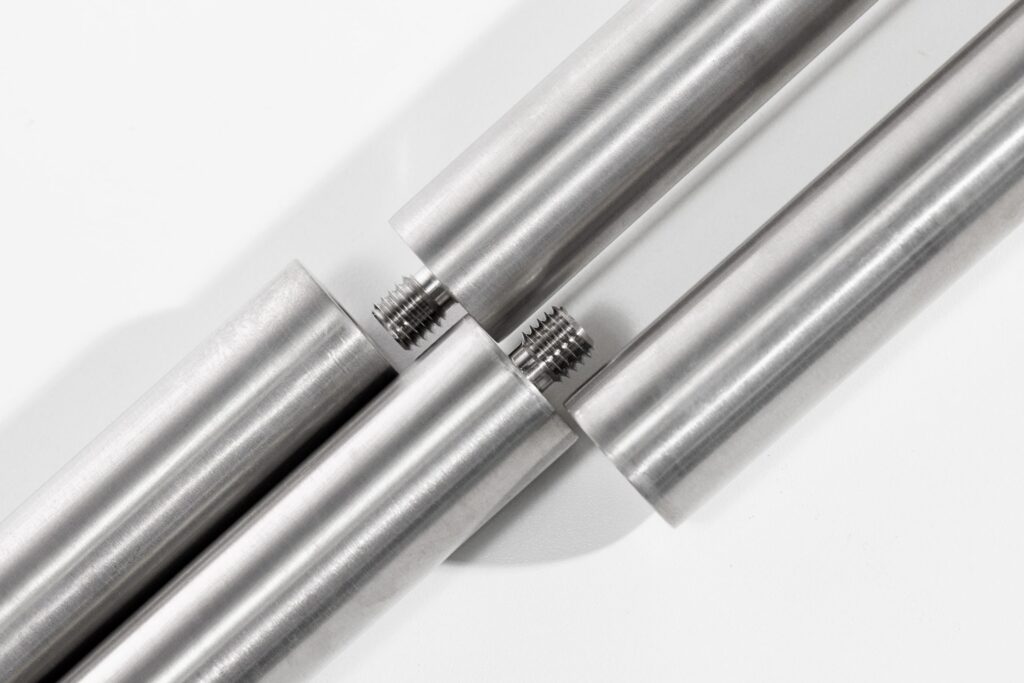
We machine bespoke geometries—including 60°/90° tapers and custom threads—engineered for your feeding system. These interfaces ensure zero-slip clamping and consistent feed rates, maintaining a stable melt zone. This prevents un-melted material from causing costly nozzle clogs, ensuring continuous operation.
High-Purity Metallurgy for Clean Powder
Forged through triple Vacuum Arc Remelting (VAR), our bars offer aerospace-grade chemical homogeneity. This in-house melting process eradicates internal inclusions and surface scale at the source, directly translating to lower oxygen levels and reduced porosity in your final powder batch. We deliver the metallurgical integrity essential for high-performance applications.
- Technical Specifications
Item
Specification / Description
Product Name | Titanium Electrode Rods for Powder Atomization |
Material Grades | Gr5 (Ti-6Al-4V), Gr23 (TC4 ELI), Gr1, Gr2, TA15, Ti-6242 |
Chemical Composition | 100% Customized per Order. Interstitial elements (O, H, N, C, Fe) are vacuum-melted and strictly verified based on your submitted Chemical Specification Sheet. |
Standards | ASTM B348, AMS 4928, ASTM F136, ISO 5832-3 |
Dimensions | Diameter Φ30mm – Φ100mm / Length up to 1500mm (Customizable) |
Straightness | ≤ 0.3mm/m (Premium precision 0.1mm/m available upon request) |
Surface Finish | Bright Turned or Precision Centerless Ground (Ra 0.8μm – 1.8μm) |
System Compatibility | 100% Custom Machined to Your Drawings. Fully compatible with EIGA (60°/90° tips) and PREP (threaded/grooved tail ends) systems. |
Rigorous Inspection & Traceable Quality
100% Certified Quality Assurance
Every batch includes EN 10204 3.1 MTC certificates. We conduct ultrasonic testing for internal voids and ELI quality testing for gas elements ensuring zero contamination.
Secure Packaging for Flawless Arrival
Rods are protected by individual custom plastic sleeves and packed in heavy-duty, foam-lined wooden crates to prevent any surface abrasion or bending during transit.
Quality Standards Met
- ISO 9001:2015 Certified check_circle
- AS9100D Aerospace Standard
- 100% Traceability from Ingot to Rod
- NADCAP Approved Material Processing
Frequently Asked Questions
Technical and logistical insights for your additive manufacturing operations.
Q1: What titanium alloy grades do you supply for EIGA powder atomization?
Answer: We supply high-purity Ti-6Al-4V Grade 5 and Ti-6Al-4V ELI Grade 23 electrode rods specifically engineered for EIGA (Electrode Induction Melting Gas Atomization) systems. We also customize specialty alloys such as Ti-6242, Ti-4822 (Titanium Aluminides), and Nitinol (NiTi) to meet strict aerospace and medical additive manufacturing powder specifications.
Q2: Why is the straightness and coaxiality of your titanium electrode rods critical for atomization?
Answer: During the EIGA process, the titanium rod rotates at high speeds. Any deviation in straightness or coaxiality causes centrifugal vibration, which leads to unstable melting and excessive satellite or oversized powder particles. Every single rod we deliver undergoes 100% laser straightness testing and precision alignment to guarantee dynamic stability during continuous high-speed rotation.
Q3: How do you prevent internal voids or cracks that might cause process interruptions?
Answer: Internal porosity, shrinkage cavities, or micro-cracks inside the rod can cause unexpected breakage or thermal splitting under rapid induction heating. To prevent this, 100% of our forged and machined titanium electrode rods undergo Ultrasonic Testing (UT) per AMS 2154 Class A and liquid penetrant inspection. This ensures full structural density and metallurgical integrity.
Q4: Can you control the grain size and grain structure of the titanium electrode rods?
Answer: Yes. We optimize the grain structure through controlled thermo-mechanical processing (forging and heat treatment). A fine, uniform, equiaxed grain structure ensures consistent electrical conductivity and uniform inductive heating across the entire rod section, resulting in a stable melt-flow rate and narrow powder size distribution.
Request a Custom Quote
To ensure 100% compatibility, we control the entire chain: Melting, Forging, Drawing, and Machining. Send us your required chemical composition and drawings (detailing end connections). We’ll review specs and quote within 1 business day.
Get a Quote
Connect with our metallurgical specialists to discuss your technical specifications.