
In the world of additive manufacturing, much attention is paid to the laser parameters and powder quality. However, the foundation of your print—the build plate—is often overlooked. Many facilities attempt to cut costs by using stainless steel substrates for Ti-6Al-4V (Grade 5) printing.
This is a critical mistake. When printing reactive metals like titanium, the substrate is not just a “holder”; it is an integral part of the thermal and metallurgical system. Here is why choosing a Titanium Build Plate is non-negotiable for professional results.
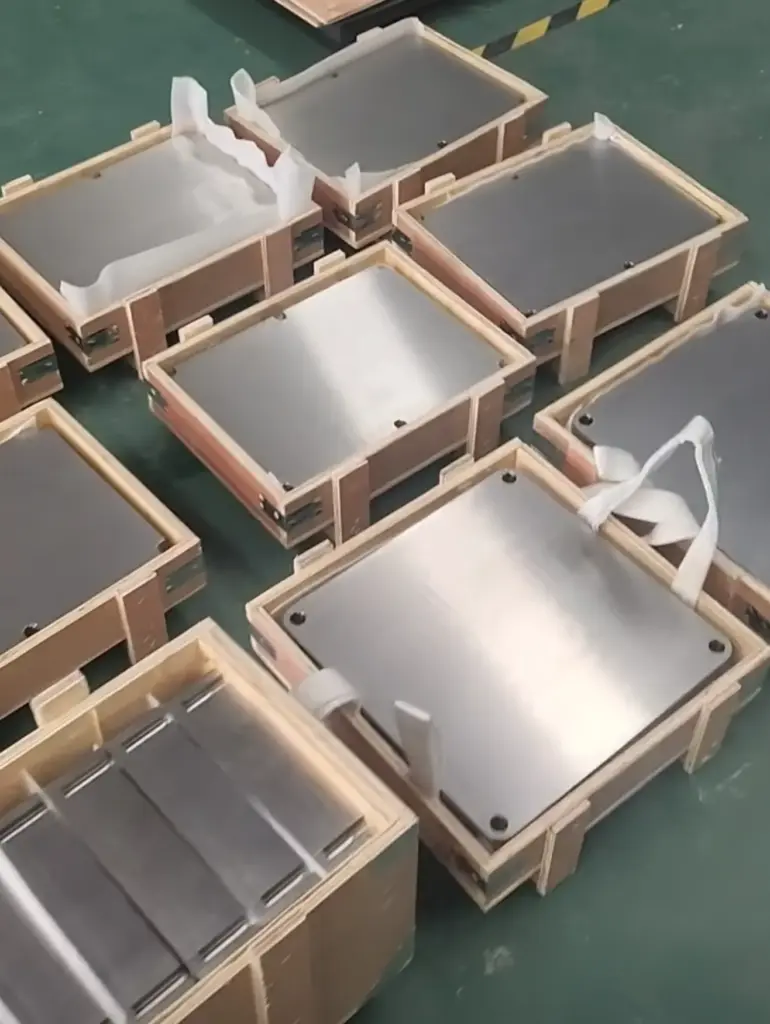
1. Eliminating Ferrous Contamination: The Purity Factor
The primary reason to use a titanium substrate is material purity.
Titanium is a highly reactive metal, especially at the elevated temperatures found in SLM, EOS, and Renishaw machines. When printed on a steel plate, iron migration occurs. Microscopic iron particles diffuse into the first layers of the titanium part.
– The Risk: For Aerospace and Medical Implant manufacturers, this is catastrophic. Even trace amounts of iron contamination can cause embrittlement and lead to immediate failure during certification (ASTM F136/F2924).
– The Solution: A Titanium-on-Titanium approach ensures zero ferrous contamination, guaranteeing the metallurgical integrity of your final component.
2. Thermal Expansion Matching: Preventing Warping & Delamination
One of the most common causes of print failure is warping. This is often caused by a mismatch in the Coefficient of Thermal Expansion (CTE) between the part and the plate.
– The Problem: Steel expands and contracts at a different rate than titanium. During the heating and cooling cycles, this mismatch creates massive shear forces at the interface. This leads to poor first-layer adhesion, edge lifting, and even the part shearing off the plate mid-print.
– The Solution: Using a Ti-6Al-4V build plate ensures that both the substrate and the part expand uniformly. This “thermal harmony” drastically reduces residual stress and prevents delamination.
3. The Power of Thermal Mass in Large Parts
As an OEM manufacturer, we often get asked: “Does the thickness matter?”
Absolutely. For large or complex geometries, thermal mass is everything.
| Feature | Thin Plate (e.g., 15mm) | Thick Plate (e.g., 40mm+) |
| Heat Distribution | Localized hot/cold spots | Uniform & Stable |
| Dimensional Variation | High risk of distortion | Minimal deviation |
| Best For | Small coupons, R&D | Structural parts, Aerospace |
A thicker plate acts as a heat sink, distributing energy evenly across the build plane. This is essential for maintaining tight tolerances in large titanium structures.
4. Cost Analysis: Initial Price vs. Total Cost of Ownership (TCO)
While a stainless steel plate is cheaper upfront, a titanium build plate offers superior ROI (Return on Investment).
1. Preventing Failed Builds: A single failed build of large titanium parts can waste thousands of dollars in powder and hundreds of machine hours. A reliable substrate prevents this loss.
2. Reusability: Unlike coated steel plates that wear out, solid titanium plates can be wire-cut, re-machined, and reground multiple times, extending their service life indefinitely.
5. OEM Replacement: Compatibility Without the Wait
As an OEM factory, we specialize in producing drop-in replacement build plates for all major platforms, including:
* EOS M290 / M400 Series
* SLM Solutions 280 / 500
* Renishaw AM400 / AM500
* GE Additive / Arcam
We don’t just copy dimensions; we optimize the heat treatment and surface finish to ensure flatness ≤ 0.05mm/m, providing a stable platform that often outperforms the original equipment.
Don’t Compromise Your Print
Choosing the right substrate is not an expense; it is an investment in part quality. For any application requiring certified Ti-6Al-4V, a dedicated titanium build plate is the only way to ensure purity, stability, and success.